
Tax treaty and international tax analysis
Domestic law and the treaty are one question, not three.
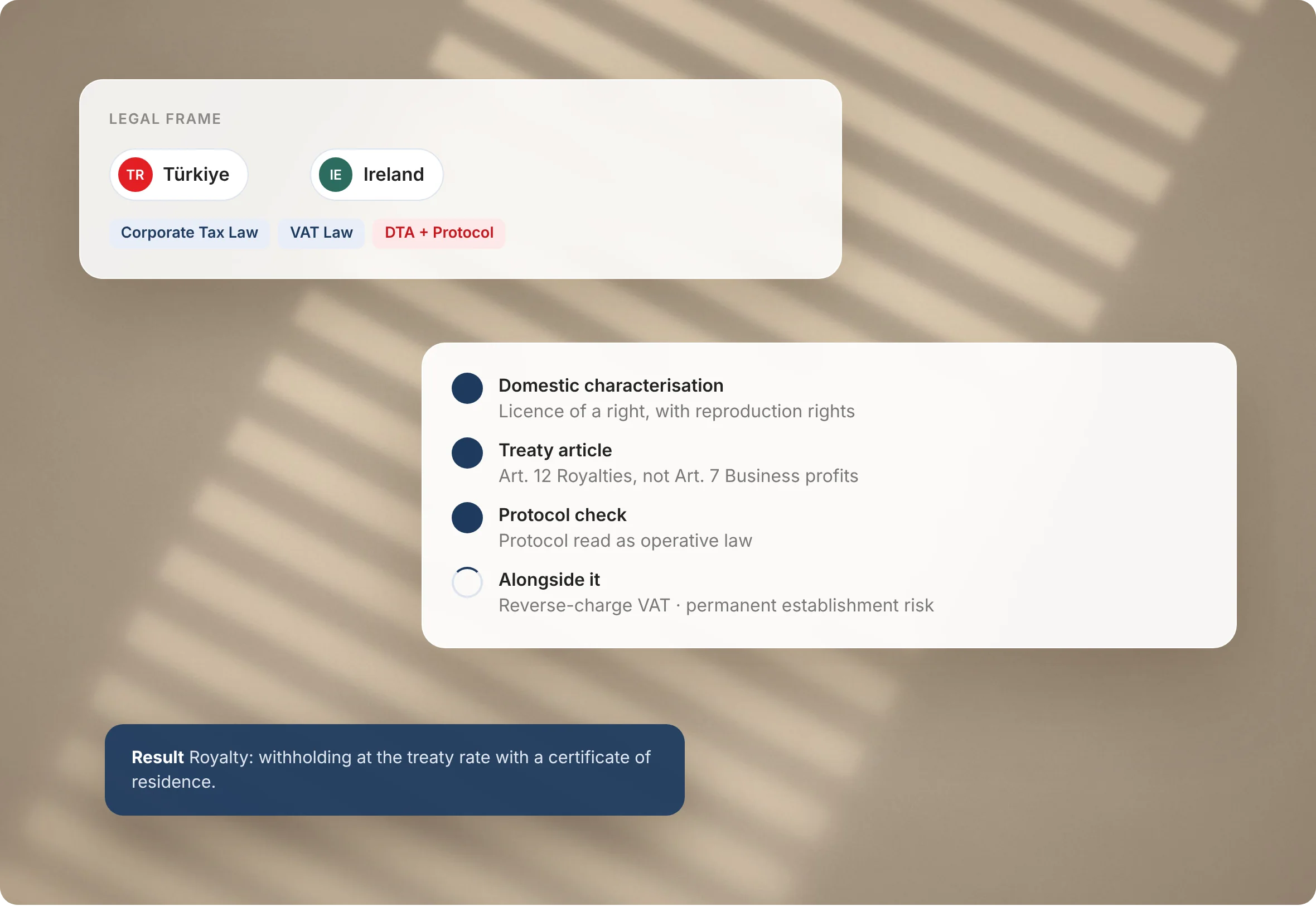
The approach
Before you ask a question, you select the jurisdictions and the acts in scope from the supported coverage. Taxtune then reasons within that frame: it characterises the income under domestic law first, applies the relevant treaty article, checks the protocol for provisions that override the article text, and tests whether anti-abuse rules in force change the result.
Protocols are treated as operative law rather than annexes, which is where a large share of real-world treaty errors originate.
Where no treaty applies or the treaty text cannot be located, the system falls back to the domestic rule and flags the gap explicitly rather than reasoning as if a treaty benefit were available.
How it works
One frame for the whole cross-border question
- Step 1
Separate headings for each exposure
Permanent establishment exposure, the taxable event date, and documentation obligations are each evaluated as their own heading.
- Step 2Planned
Multi-jurisdiction selector
Sets the legal frame for the session, and can be saved to a client profile.
- Step 3Planned
Treaty layer
Full texts, protocols, and competent-authority guidance for each supported country pair.
- Step 4Planned
Anti-abuse as its own control step
Anti-abuse and multilateral instrument effects run as a separate control step, not folded into the treaty article analysis.
Coverage
Supported coverage today
Taxtune currently covers all tax legislation, tax treaties, customs, social security, banking, Capital Markets Board, MASAK (Financial Crimes Investigation Board), Tax Audit Board, import-export and external trade regulations and supplementary laws (e.g. Commercial Code) related to tax laws in Türkiye as well as OECD/UN Guidance and Reports, with expansion to all major countries coming soon.
Domestic law
All tax legislation of Türkiye, plus customs, social security, banking, Capital Markets Board, MASAK, Tax Audit Board, import-export and external trade regulations, and supplementary laws such as the Commercial Code.
Tax treaties
All tax treaties of Türkiye.
International guidance
OECD and UN guidance and reports.
Next
All major countries — published as each jurisdiction is validated.
On a cross-border royalty arrangement, Taxtune separates the sale of a right from the licensing of one, applies the protocol provision that governs the distinction, states the treaty rate, and identifies whether reverse-charge VAT and permanent establishment risk arise alongside it.