
Uncertainty made visible
The hardest professional skill is knowing when not to give an opinion.
Taxtune answers from a closed, verified knowledge base of primary legislation, regulations, administrative rulings, and case law. It does not draw on the open internet, and it does not fill gaps with plausible-sounding text. If the supporting authority is not in the corpus, it is designed to say so.
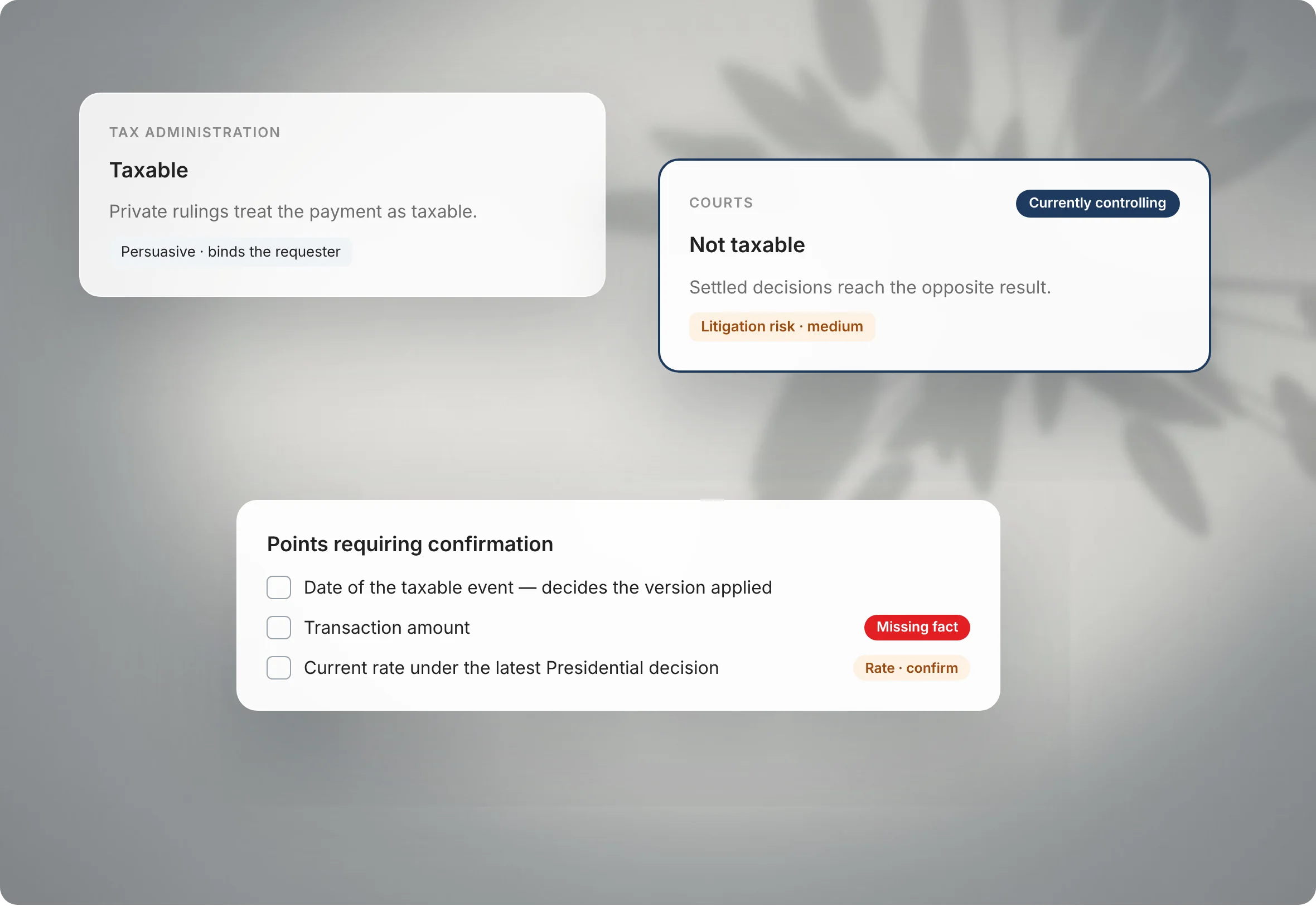
The approach
Answers are tiered by how settled the question actually is. Where the rule is clear and the facts are complete, Taxtune answers directly. Where the tax authority’s position and the courts’ position diverge, it presents both and identifies which is currently controlling.
Where the outcome turns on facts you have not supplied, it names the missing fact rather than assuming one. Rates, thresholds, and other frequently amended figures are flagged for confirmation on principle, because a memorised number is a stale number.
Every answer closes with a section identifying points that require confirmation. This is not a disclaimer. It is a work list.
How it works
Built to say what it cannot support
- Step 1
No supporting passage, no assertion
Grounding is enforced at generation.
- Step 2
Response layers by question type
Characterisation, conditions and timing, calculation, effective date, cross-border, or genuine uncertainty — each layer has its own required structure.
- Step 3
Amended figures tagged
Frequently amended figures are tagged for verification rather than hard-coded, so the system prompts you to confirm the current parameter.
- Step 4
Self-check before delivery
Tests whether distinct mechanisms — exemption, exclusion, deduction, withholding, filing obligation — have been improperly merged into one chain of reasoning.
If you ask a question where the tax authority’s rulings and settled court decisions point in opposite directions, Taxtune sets out both positions, identifies the litigation risk, and tells you what a defensible filing position looks like, instead of picking one and sounding certain.